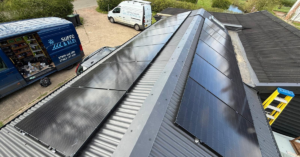
For most people, solar panels mean lower energy bills and greater independence from the grid – but still very much connected to it. Your panels generate electricity, you use what you can, and the grid fills in the gaps when you need it.
But there’s a growing number of homeowners, landowners and rural property owners across Suffolk who are asking a different question entirely.
What if I didn’t need the grid at all?
Off-grid solar is no longer the niche, complex proposition it once was. The technology has matured significantly, the economics have improved, and for the right property in the right situation, it can be a genuinely compelling option.
Here’s what you need to know.
What Does Off-Grid Actually Mean?
An off-grid solar system is one that operates completely independently of the national electricity grid. Rather than supplementing your grid supply with solar energy, an off-grid system is designed to meet all of your property’s electricity needs – generated by solar panels and stored in a battery system large enough to cover your usage when the sun isn’t shining.
This is different from a standard solar and battery installation, where the grid acts as a backup when your battery is depleted. In a true off-grid system, there is no grid connection – your solar panels and battery bank are your only source of electricity.
For some properties, that’s not just an attractive idea – it’s a practical and financially sound one.
What Kind of Properties Suit Off-Grid Solar?
Off-grid solar isn’t right for every property – but there are situations where it makes excellent sense.
Properties in rural or remote locations where a grid connection is expensive or impractical to establish are perhaps the most obvious candidates. If your property doesn’t currently have a mains electricity connection, the cost of establishing one can be substantial – and in many cases, an off-grid solar system represents a more cost-effective and more sustainable alternative.
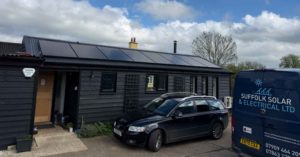
Agricultural buildings, outbuildings, lodges, holiday lets and annexes that are separate from the main property are also well suited to off-grid solar. Rather than running costly cables from the main building or applying for a new grid connection, a self-contained off-grid system can provide reliable, independent electricity at a fraction of the infrastructure cost.
Even some homeowners with existing grid connections are choosing off-grid or near-off-grid systems simply because they want maximum energy independence – freedom from rising energy prices, grid outages, and reliance on energy suppliers altogether.
How Does an Off-Grid System Work?
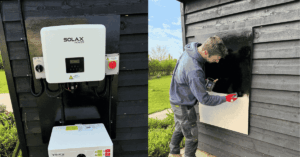
The core components of an off-grid solar system are the same as a standard solar installation – panels, an inverter, and a battery – but the scale and specification are different.
Because the system needs to meet all of your electricity needs without any grid backup, both the solar array and the battery storage need to be sized carefully around your property’s energy consumption. The battery bank in particular needs to be large enough to carry you through periods of low solar generation – overcast winter days, for example – without running out of power.
This is why the design of an off-grid system requires particularly careful thought. Getting the sizing right is critical. Too small and you’ll run short of power at the wrong moment. Too large and you’ve overspent on capacity you don’t need.
At Suffolk Solar & Electrical, we approach every off-grid project with the same care and attention to detail we bring to all our installations – starting with a thorough assessment of the property and its energy requirements before a single component is specified.
What About Winter and Cloudy Weather?
This is one of the most common questions we’re asked about off-grid solar – and it’s an important one.
Suffolk’s winters bring shorter days and more overcast conditions, which means solar panels generate less electricity than they do in summer. For a grid-connected system, the grid simply fills the gap. For an off-grid system, the design needs to account for this from the outset.
There are several ways to approach this. A larger battery bank can store more energy during productive periods to carry the property through several days of low generation. A larger solar array generates more even in low light conditions. And in some cases, a backup generator is incorporated as a secondary source of power for extended periods of very low solar output — particularly through the depths of winter.
The right solution depends on the property, its location and its energy needs – which is exactly why a proper assessment is the essential first step.
What Does Off-Grid Solar Cost?
Off-grid systems are generally more expensive than standard grid-connected installations, primarily because of the larger battery capacity required and the additional complexity of the design and installation.
However, the cost needs to be considered in context. For a property that would otherwise require a significant investment to establish a grid connection, an off-grid solar system can represent genuine savings – both upfront and over the long term. And for any property, the ongoing cost of electricity from the grid is eliminated entirely, which changes the financial picture considerably over the lifetime of the system.
As with all our installations, we’ll always provide a clear, fully itemised quote built around your specific property and requirements – so you have a complete picture of the investment and what it will deliver before you commit to anything.
Hybrid Systems: A Middle Ground
It’s worth mentioning that off-grid and grid-connected aren’t the only two options. Hybrid solar systems offer a middle ground – primarily operating from solar and battery storage, with a grid connection available as a backup when needed.
For homeowners who want maximum energy independence without fully cutting the cord, a hybrid system can be an attractive proposition. You benefit from the self-sufficiency of an off-grid setup for the vast majority of the time, with the security of a grid connection for those occasional periods when your system needs support.
Whether a fully off-grid or hybrid approach is right for your property is something we can discuss as part of your free survey.
Why Off-Grid Solar Makes Sense Right Now
Energy prices have risen significantly in recent years, and the case for generating and storing your own electricity has never been stronger. For properties where off-grid solar is a realistic option, the combination of rising grid costs, improved battery technology and falling solar panel prices has made the proposition more compelling than ever.
Add to that the growing desire among homeowners and landowners for genuine energy independence — freedom from price fluctuations, supplier changes and grid reliability — and it’s easy to see why interest in off-grid solar is growing across Suffolk.
Interested in Off-Grid Solar for Your Property?
If you’re considering off-grid solar – whether for a rural home, an agricultural building, an outbuilding or any other property – we’d love to have a conversation.
At Suffolk Solar & Electrical, we specialise in off-grid solar installations across Suffolk. We’ll visit your property, assess your energy needs, and give you an honest picture of what an off-grid system could look like and what it would cost – with no obligation to go ahead.
We work across:
📍 Ipswich · 📍 Woodbridge · 📍 Stowmarket · 📍 Surrounding Suffolk areas